
The 8-Minute Goal: A Practical Guide to Independent Play in Autism
Independent play in autism takes teaching, not just time. See the fading schedule, environment setup, and parent-training steps Blue Jay ABA uses with families.
A mother asked me last spring whether her six-year-old would ever play alone long enough for her to start dinner. He could line up dinosaurs for forty minutes with real focus, but only while she sat three feet away. The second she stood up, he was in the kitchen holding her leg. She was not asking for a miracle. She was asking for eight minutes.
Independent play in autistic children is a teachable skill with a fairly predictable structure. Children build it when the activity itself becomes rewarding enough to compete with adult attention, when the steps of the play are taught before support is withdrawn, and when the adult fades out in increments small enough that the child barely registers the change. Progress is usually measured in added minutes rather than transformed afternoons.
What follows is the sequence we use with families across North Carolina and Colorado, along with the sticking points that show up in almost every home.
What independent play looks like in an autistic child
Before you can build the skill, it helps to agree on what you are building. Parents often picture a neurotypical version of solo play, a child inventing storylines with figurines for an hour, and then measure their own child against that image. The target should be functional engagement, not a particular style of play.
Solitary play and disengaged play look similar from across the room
A child spinning a wheel on an overturned truck for twenty minutes and a child building a track for that truck are both playing alone, but they are doing different things. The first is usually sensory and self-regulatory. The second involves a sequence with a beginning and an end.
Both have a place. When families tell me their child "plays alone all the time" and still cannot be left for five minutes, the play is almost always sensory and interrupted easily. Sensory play soothes; sequenced play occupies. You want some of each.
Repetition inside play is often the point
Lining up, sorting, and re-running the same three actions is not a sign that play has stalled. Repetition is how many autistic children establish predictability inside an activity, and predictability is what allows them to stay in it without an adult managing the uncertainty. We wrote more about this pattern in our piece on lining up toys.
The clinical question is whether the repetition can be extended, varied slightly, and ended without distress. If yes, it is a foundation. If the child cannot tolerate any change to the sequence, that inflexibility becomes the first teaching target.
The realistic starting number is smaller than parents expect
When I run a baseline in a family home, I am often measuring in seconds. A child who plays alone for ninety seconds before seeking an adult has a baseline of ninety seconds, and the first goal is two minutes, not twenty.
Families who start from an honest baseline tend to stick with the plan. Families who start from an aspirational one usually abandon it in the second week.
Why building independent play takes longer in autism
Independent play sits on top of several other skills, and in autism those skills often develop unevenly. Understanding which piece is missing changes what you teach first. The National Institute of Child Health and Human Development describes autism as affecting how a child learns, plays, and interacts, which is why play is treated as a developmental domain in its own right rather than a break from learning.
Play skills develop in a different order
Typical play moves roughly from exploring objects, to using objects functionally, to combining them, to pretending. Many autistic children have strong skills at one level and almost none at the next, so a child may sort colors beautifully and have no idea what to do with a doll.
When a step is missing, solo play collapses at that exact point. The child runs out of ideas, and the adult becomes the source of the next idea.
Regulation uses up the energy exploration needs
A child managing background sensory input has less capacity left for open-ended play. In practice this looks like a child who plays well in a quiet bedroom at 4 p.m. and cannot play at all in the living room after school.
This is why we look at the environment before we look at the child. Small changes to noise, lighting, and clutter often buy several minutes on their own.
Adult support becomes part of the activity
This one surprises parents. If a child has only ever played while a parent narrates, hands over pieces, and reacts to each step, then the parent has become a component of the play, the way a battery is a component of a toy. Remove it and the activity stops.
Clinically this is called prompt dependence, and it develops through kindness rather than error. Our guide to the prompt hierarchy explains how support is layered and, more importantly, how it comes back off.
A step-by-step approach to independent play at home
The sequence below is the one I teach in parent sessions. It works best when you run it at the same time each day, in the same spot, for two to three weeks before you judge it. Consistency does more work here than cleverness.
Begin with what your child already picks up
Watch for three days and write down what your child chooses when nobody directs him. Preferred activities are the ones that will hold attention without you, and preference in autism is often narrow and intense.
Do not start with the toy you wish he liked. Start with the one he goes to on his own, then broaden later.
Teach the whole sequence before you step back
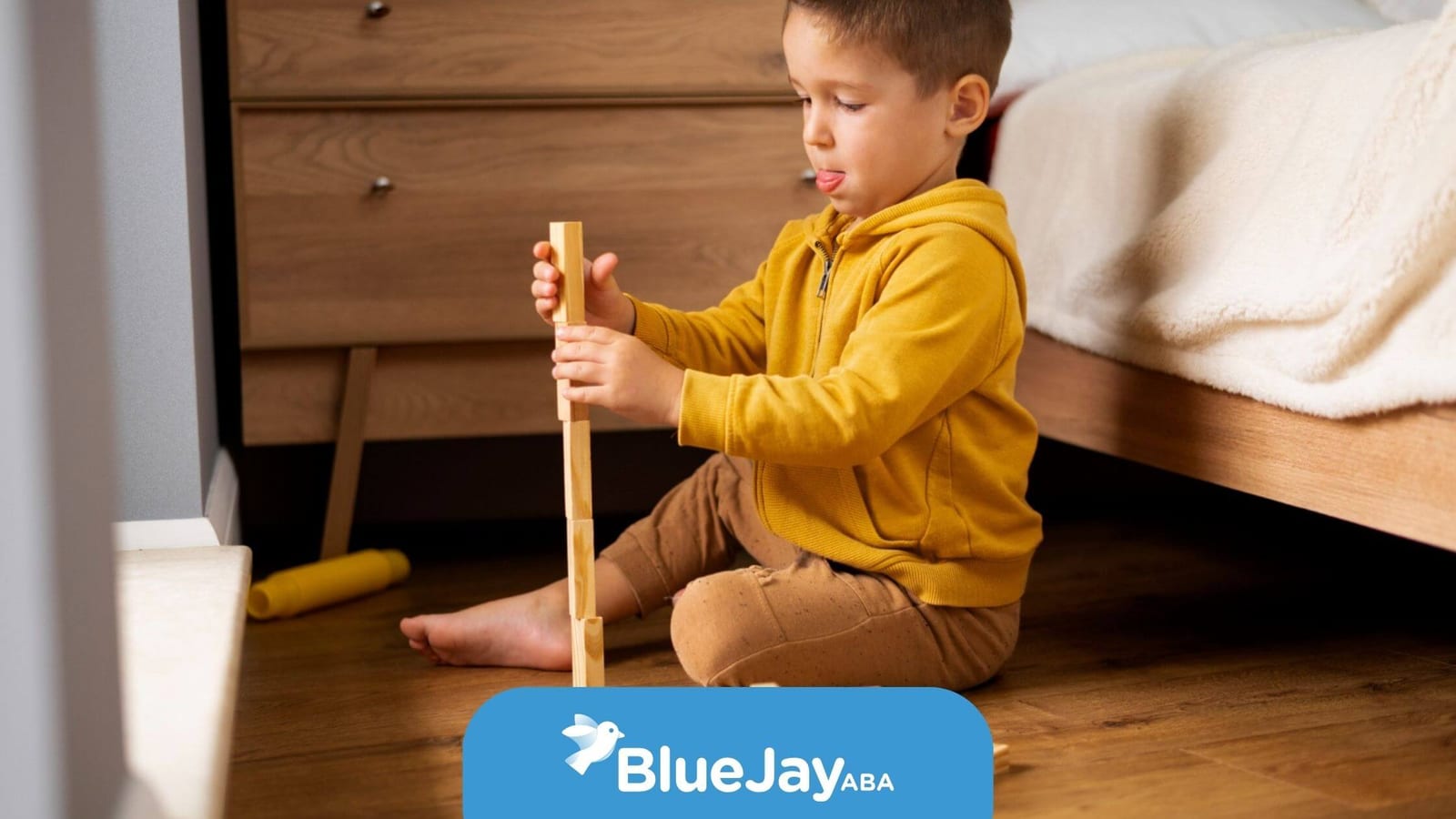
Break the activity into steps and teach them until your child can run the whole thing with you present. A simple magnetic tile build might be: open the bin, place four tiles, add a figure, put the tiles away.
This is task analysis, and in ABA we usually teach the steps through chaining, either forward from the first step or backward from the last. Backward chaining suits play well because the child finishes the activity every single time, and finishing feels good.
Fade your presence in small, boring increments
Once the sequence is solid, start withdrawing. The increments should feel almost insultingly small.
- Sit beside your child and stop talking.
- Turn your body a quarter away and look at your phone.
- Move to a chair four feet back.
- Stand and stay in the room.
- Step to the doorway for fifteen seconds, then return before your child seeks you.
- Step out of sight for thirty seconds while remaining audible.
The returning-before-they-seek-you detail is the part families skip, and it is the part that works. If you always come back before your child has to search for you, absence stays predictable rather than becoming a threat.
Give the passage of time a visual form
Autistic children often struggle to estimate how long an adult has been gone. A visual timer, a sand timer, or a simple card that says "Mom comes back when the sand is down" makes duration concrete.
Visual supports are among the evidence-based practices catalogued by the National Clearinghouse on Autism Evidence and Practice at UNC, and they cost almost nothing to implement at home.
Let the environment carry some of the instruction
A play space that answers "what do I do next" reduces how often your child needs you to answer it.
- Put one activity in one clear bin rather than mixing four sets together.
- Use a low shelf with three visible choices rather than a toy box.
- Mark a play boundary with a rug or a taped square so the space has an edge.
- Keep a finished basket so there is an obvious place for completed work.
Families looking for fresh options can pull from our list of activities at home, but rotate slowly. Novelty every day undoes the predictability you are trying to build.
Troubleshooting the moments where solo play breaks down
Almost every family hits one of four walls. None of them mean the plan has failed, and each has a specific adjustment.
Your child follows you from room to room
Shadowing usually means the fade happened faster than the child could absorb. Go back two steps and shorten your absences until they are shorter than his tolerance, not longer.
It also helps to make leaving unremarkable. No announcements, no goodbyes, no negotiation at the doorway.
Play stops the second you stop narrating
If your child looks up every time you go quiet, your attention has been reinforcing each step. Move your responses to the end of the activity rather than through it, and start with a short delay before you comment. Three seconds, then five, then ten.
The same ninety seconds, over and over
Short and repetitive play often means the sequence is too thin to fill time. Add one step to the end, not the middle, and teach that step directly.
A child who takes out four cars and stops can be taught to add a ramp, then a garage, then a cleanup step. Each addition buys minutes.
A sibling changes the whole setup
Solo play and shared play are different skills and should be practiced separately. Run independent play at a time when siblings are occupied, and work on shared play in its own window. When you are ready to combine them, our guidance on inclusive playdates covers structuring time with peers so both children get something out of it.
How ABA therapy supports independent play in autistic children
Plenty of families build independent play on their own with a good plan and consistent practice. Others need a clinician in the room, particularly when play is limited to one or two activities, when leaving triggers significant distress, or when the child has few functional communication skills to begin with. With autism identified in about 1 in 31 eight-year-olds according to CDC surveillance data, demand for structured support has grown quickly, and the quality of the plan varies widely between providers.
Assessment sets the starting point
Our work begins with an ABA assessment, where a Board Certified Behavior Analyst observes play directly, samples preferences, and measures how long your child sustains activities under different conditions. Families who do not yet have a diagnosis can start with an autism evaluation.
The assessment produces a baseline and a target, which is what lets you tell in week six whether anything has changed.
The setting shapes what gets taught
Where therapy happens changes what can be practiced. In-home ABA therapy allows us to work in the actual room, with the actual toys, at the hour of day when play tends to fall apart.
School-based ABA therapy targets the same skill in a different form, since independent work during centers or free choice draws on the same behaviors. For families in rural parts of the state or with tight schedules, telehealth ABA therapy works well for play coaching specifically, because the parent is the one running the session while the clinician observes and adjusts.
We provide these services across North Carolina and Colorado.
Parent training keeps the skill alive between sessions
Independent play is practiced in the ordinary hours, not in therapy hours, so ABA parent training is where most of the durable gains come from. Sessions usually cover how to run a fading schedule, how to respond when your child seeks you early, and how to avoid rebuilding prompt dependence without noticing.
Tracking progress without turning play into work
Data keeps you honest, but it should take less than a minute a day. If measurement starts to feel like a second job, you will stop, and then you will have no idea whether anything is working.
Three things worth writing down
- Minutes of play before your child seeks you out.
- How far away you were when it ended.
- Whether the ending was calm or distressed.
Three numbers on a sticky note on the fridge is enough. Our post on tracking progress covers simple systems that families sustain.
A realistic timeline
Most children I work with add a few minutes over four to six weeks of steady practice, then hit a plateau, then move again. Plateaus are normal and usually mean the play sequence needs another step rather than that the fading needs to be faster.
Progress also varies with age, language, co-occurring anxiety, and sleep. I am careful not to promise a number, because I have seen a four-year-old go from two minutes to fifteen in a month and a nine-year-old take a full season to reach ten.
If you would like help building a plan for your child, contact Blue Jay ABA to talk with our clinical team about assessment and next steps in North Carolina or Colorado.
Frequently asked questions about independent play in autism
At what age should an autistic child be able to play alone?
There is no fixed age. Developmentally, many neurotypical children manage short stretches of solo play by two or three, but autistic children commonly reach that later and along a different path. Chronological age is less useful here than a current baseline and a trend line.
Is it harmful to let my autistic child play alone for long periods?
Solo play is healthy in balance. Concern is warranted when it becomes the only mode of play, when it crowds out communication opportunities, or when the child appears distressed rather than content. A mix of solo play, parallel play, and interactive play is a reasonable target.
My child only wants screens when left alone. What should I do?
Screens compete with almost everything else, so start by running independent play practice at a time when screens are not on the table at all. Build the non-screen habit in its own window, then decide separately how screen time fits into the day.
Does encouraging independent play mean ignoring my child?
No. The method is built on planned, predictable returns, and you are present at the start of every session. You are teaching your child that your leaving is temporary and your coming back is reliable, which is close to the opposite of ignoring.
What if my child cries every time I leave the room?
Shorten the absence until it is brief enough that crying does not begin, then extend by a few seconds at a time. If distress is intense, frequent, or escalating, that is worth raising with your clinician rather than pushing through.
Can independent play skills be taught to nonspeaking children?
Yes. Play skills do not depend on speech. Nonspeaking children build solo play through the same sequence, usually with heavier use of visual supports and sometimes with a communication system in place so the child can request help rather than escalate.
How many hours of ABA therapy does this take?
Independent play is normally one goal inside a broader treatment plan rather than a standalone service, so hours are set by overall clinical need. Your BCBA determines recommended hours during assessment and revisits them as goals change.
Sources:
- CDC, Data and Statistics on Autism Spectrum Disorder: https://www.cdc.gov/autism/data-research/index.html
- NICHD (NIH), Autism Spectrum Disorder fact sheet: https://www.nichd.nih.gov/health/topics/factsheets/autism
- AFIRM, Frank Porter Graham Child Development Institute, UNC Chapel Hill: https://afirm.fpg.unc.edu/afirm-modules/afirm/