Autism Aggression and Self-Injury: What a BCBA Does Differently
Hitting, biting, or hurting themselves? See how a BCBA finds the reason behind autism aggression and self-injury and builds a plan that keeps everyone safe.
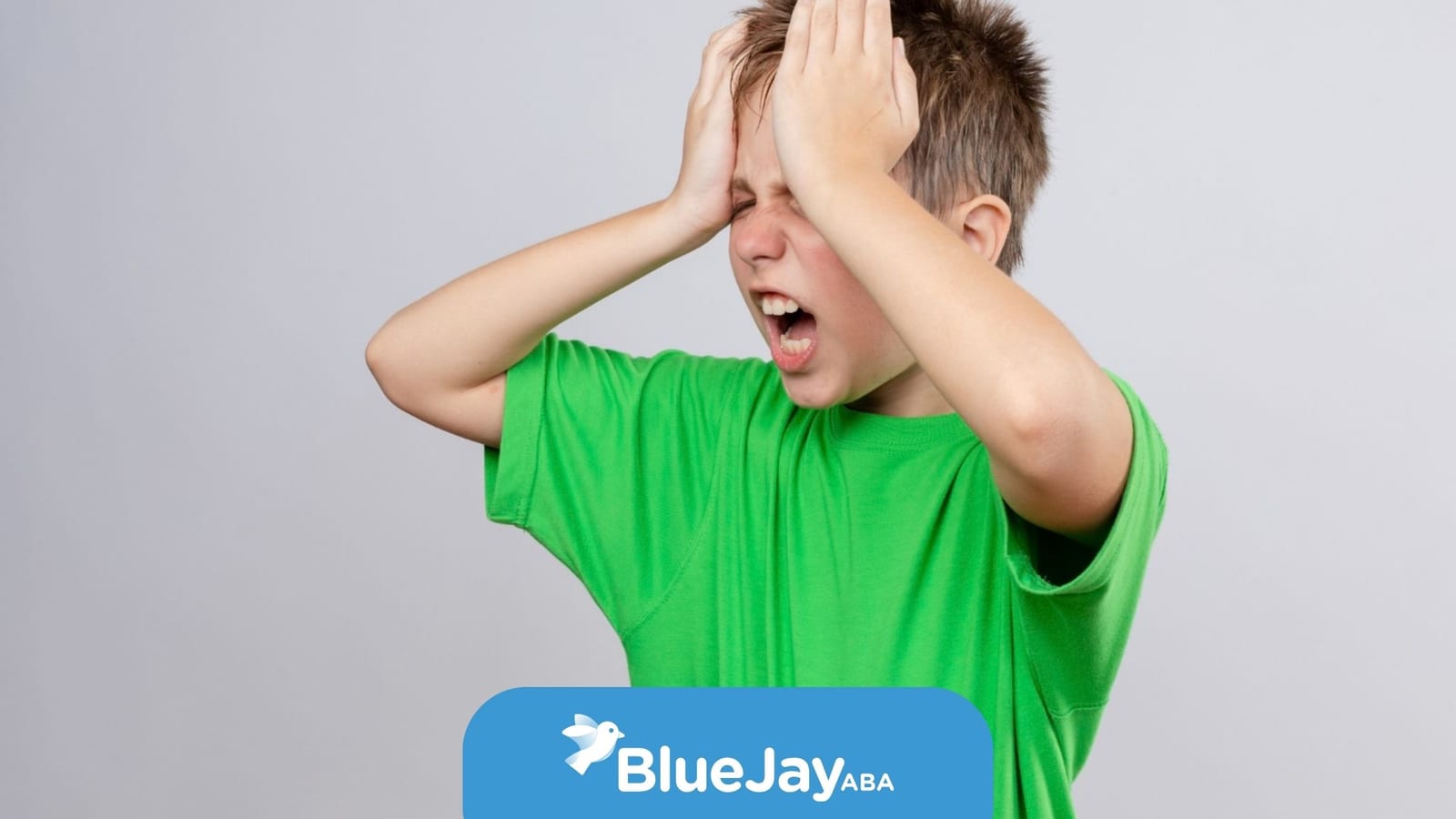
A child hits a parent during homework. Another bangs a fist against their own forehead in a quiet room on a calm afternoon. In both moments, the instinct is to make the behavior stop as fast as possible.
A BCBA starts somewhere else. We ask what the behavior gets the child, whether something in their body hurts, and which safer skill could do the same job. Then we build a plan that keeps everyone protected while that skill grows.
Autism aggression and self-injury are common, they almost always have a reason, and they respond best to a plan built around that reason. At Blue Jay ABA, our clinicians support families across North Carolina and Colorado with exactly this, and the sections below show how we work.
Early in my career, a mother told me she had stopped grocery shopping with her son because she never knew which version of him would walk through the doors. I hear some form of that sentence in nearly every first meeting. It tells me the family is in survival mode and nobody has handed them a plan yet.
Why Autism Aggression and Self-Injury Happen
These behaviors are common in autism, and they nearly always serve a purpose for the child. Knowing how often they occur and what drives them takes some of the guilt and mystery out of hard days.
How common these behaviors are
CDC surveillance found that about 1 in 31 eight-year-olds was identified with autism in 2025, so a lot of families are working through this at the same time. Within that group, aggression is one of the most frequently reported concerns. In a study of 1,380 children and adolescents, parents reported that 68% had shown aggression toward a caregiver at some point and 49% toward someone outside the family.
Self-injury is just as familiar. A meta-analysis pooling data from 14,379 participants across 37 papers estimated that about 42% of autistic people show some form of self-injury, with hand-hitting the most common type. Individual studies vary widely, so treat any single percentage as a rough guide and not a forecast for your child.
If your child is somewhere in those numbers, you did not cause this. It also does not mean the situation is fixed.
The reasons we see most often
Every behavior does a job for the child. In ABA therapy, we call that job the function, and it usually falls into one of four groups:
- Escape or avoidance: the behavior ends or delays a demand, a transition, a loud room, or a task that feels too hard.
- Access: the behavior gets a preferred item, food, activity, or place.
- Attention: the behavior brings a person closer, even when the reaction is a stern one.
- Automatic or sensory: the behavior feels good or relieves discomfort whether or not anyone responds.
Two children can slap their own face in exactly the same way. One does it when asked to clean up toys, and the other does it alone in a quiet room. The movement looks identical, but their plans have almost nothing in common.
Pain, illness, and poor sleep can sit underneath any of these four, which is why our first step comes before any behavior program.
The First Step Is Ruling Out Pain and Medical Causes
Before we write a single behavior goal, we ask whether something in your child's body is hurting. A child who cannot say "my stomach hurts" may say it with a fist, a bite, or a head bang.
Signs worth raising with your pediatrician
Constipation, reflux, dental pain, ear infections, and poor sleep come up again and again in the families I work with. Guidance summarized from the American Academy of Pediatrics says hidden gastrointestinal discomfort should be considered when a child's behavior changes, including outbursts of aggression or self-injury. These are the signals I ask parents to mention at the next appointment:
- A sudden change in behavior with no clear trigger
- Changes in sleep, appetite, or toileting
- Holding the belly, avoiding lying flat, or pressing on the stomach
- Hitting or pressing the ears, jaw, or head
- Self-injury aimed at one body area, especially the same spot every time
- Behavior that rises and falls with illness or constipation
One boy I supported bit his own hand every day. Our plan barely moved until his pediatrician found an ear infection. Once that was treated the biting dropped noticeably, and what remained responded well to the behavior plan.
How we work alongside your child's doctor
A BCBA does not diagnose medical conditions, but we can collect useful information. When we hand a pediatrician a record of when the behavior happens, how often, and what came before it, the doctor sees a pattern and not just a worry.
We keep behavioral support going while medical questions get answered, because the two tracks run side by side. For some children with severe aggression or self-injury, a physician may also discuss medication alongside behavioral support. That decision belongs to you and your child's prescriber.
How a BCBA Finds the Reason: The Functional Behavior Assessment
The functional behavior assessment, or FBA, replaces guessing with data. It is the foundation for every strategy that follows, and we cover the full process in our post on functional behavior assessment.
What we collect and how you can help
An FBA combines parent interviews, direct observation, and a record of what happens before and after the behavior. In our in-home ABA work, I can watch behavior in the actual kitchen, living room, and car where it happens. That setting often tells me more than a clinic ever could.
You can start the record today. Jot down the time, what happened right before, what your child did, and what happened right after:
Time | Right before | What your child did | Right after |
4:10 pm | Asked to start homework | Hit mom's arm | Homework put away |
4:45 pm | Tablet turned off | Screamed, bit own hand | Tablet returned |
7:30 pm | Alone in room, nothing to do | Hit forehead with fist | Dad came in to talk |
Even three entries like these point toward escape, access, and attention or sensory functions. We also note setting events such as a poor night of sleep, hunger, illness, or a schedule change, because they make everything harder.
When a functional analysis is used
Sometimes the data do not give a clear answer. In those cases a BCBA may run a functional analysis, which tests specific conditions in a controlled way to see what drives the behavior. For serious self-injury this is done only with strong safeguards, and never casually.
Which behavior we address first
Safety comes first. Behaviors that injure your child or other people move to the top of the list, ahead of bedtime battles or picky eating. Our post on how clinicians prioritize behaviors explains how we order the list and why.
Building a Behavior Plan That Teaches, Not Just Reacts
Once we know the function, the behavior intervention plan, or BIP, has four parts: prevention, teaching a new skill, reinforcement, and a response plan for hard moments. Several of these strategies appear among the evidence-based practices that the University of North Carolina's AFIRM project trains professionals to use.
Prevention: change what comes before
Many episodes can be prevented by adjusting the setting. Visual schedules, first-then boards, countdown warnings, and a short break built into a long task often lower the odds of a blow-up before it starts. Splitting a worksheet into two chunks, or pre-teaching a hard transition, can make the same demand much easier to accept.
Hearing "no" is a common trigger, and we have a full post on hearing no with phrasing that lowers the temperature.
Replacement skills: teaching a better way to ask
Functional communication training, or FCT, teaches a child to meet the same need with a safer response, such as a word, a picture card, a button, a sign, or an AAC device. UNC publishes a free FCT brief packet that shows how this is planned and monitored.
Take a child who hits to escape math. We teach a "break" card and honor it immediately at first, so the card works faster than the hit ever did. Later we stretch the time between request and break, and we teach "wait" and "not right now" in small steps.
Reinforcement: making the new skill pay off
A new skill only survives if it works. We reinforce the replacement response every time at the start and then thin it out slowly. When a behavior is very frequent, we may also reinforce stretches of time without it, a strategy explained in our post on DRO in ABA.
We are cautious with extinction, which means no longer delivering the outcome that has been maintaining a behavior. When it is used without a replacement skill, behavior can briefly get more intense before it improves. With self-injury, that risk is unacceptable unless safeguards are in place.
Responding in the moment
Every plan needs a script for the hardest minutes, written down so nobody has to improvise. The version I teach most often looks like this:
- Keep your voice low and your words few.
- Move other people and breakable or dangerous objects out of the way, and move your child only if safety requires it.
- Offer the replacement skill if your child can use it, and give space if not.
- Wait until your child is calm before teaching or talking about what happened.
- Check for injuries afterward, then write down what you saw.
Physical restraint carries real injury risk and is not a parent-training strategy. If a hold is ever used at school or in therapy, ask for the written policy and the training behind it. Not every escalation is the same, and our post on meltdown versus panic helps you read what you are seeing.
Keeping a Child Safe When Self-Injury Is the Concern
Head banging, hand biting, and face hitting add a physical safety layer to the plan. The goal is to protect your child's body while the behavior plan does its work.
Protecting your child while the plan takes hold
Increase supervision during the times your data show are riskiest. Soften the places where head banging tends to happen with rugs, cushioned corners, or a padded play area, and keep the replacement tools, such as a break card or communication device, within your child's reach.
Please do not add helmets, arm splints, or other protective equipment without direction from your child's physician. These devices carry their own risks, and they work best when paired with a plan to fade them.
When to call the doctor or emergency services
Call 911 or go to the nearest emergency room if your child has any of these after a head injury:
- Loss of consciousness, confusion, or unusual sleepiness
- Repeated vomiting
- A seizure
- Clear fluid from the nose or ears
Call your pediatrician the same day for an eye injury, a deep wound or bleeding that will not stop, signs of infection, or injuries that are new or getting worse. Self-injury in autism usually serves a communication or sensory function, but any talk of wanting to die needs immediate attention. Call or text 988, or go to the nearest emergency room.
Aggression at School and in the Community
School is often where families first read the word "aggression" in an email or hear it in a phone call. The rules and supports there differ from home, so it helps to know your options.
Asking for an FBA and behavior plan at school
Federal special education rules reference FBAs and BIPs in several situations. For example, a child removed from their placement for conduct must receive, as appropriate, a functional behavioral assessment and behavioral intervention services, and a behavior found to be a manifestation of a disability triggers an FBA and plan.
You do not have to wait for a crisis. You can ask your child's IEP team in writing to consider an FBA and BIP, and you can ask that the plan teach skills rather than rely on removal. Your district's exceptional children's program is the office that handles these requests.
Coordinating home, school, and therapy
Children do best when the same function-based plan runs in every setting they live in. Our school-based ABA therapy team works alongside teachers so the break card at home is the same break card in the classroom. Consistent language across adults is one of the biggest predictors of whether a new skill sticks.
How Blue Jay ABA Supports Families in North Carolina and Colorado
We build behavior plans around your child's real routines, and we bring parents into every step. Here is how that looks in practice.
Assessment, in-home therapy, and parent training
Care starts with an ABA assessment that includes the FBA process described above. From there, our BCBAs and RBTs deliver therapy at home and coach caregivers through ABA parent training, with telehealth ABA available for coaching between visits.
If your child does not have a diagnosis yet, an autism evaluation is the first step, since insurance typically requires one before ABA begins. Our team can walk you through insurance coverage and the paperwork.
Where families can reach us
We serve families across North Carolina, including Charlotte, Raleigh, Durham, and Greensboro. In Colorado, we support families in Denver, Aurora, and surrounding communities.
If your child is hitting, biting, or hurting themselves and you are not sure where to begin, contact Blue Jay ABA. We will listen first, then help you find the right next step.
Frequently Asked Questions About Autism Aggression and Self-Injury
Is aggression common in autism?
Yes. In one study of 1,380 children and adolescents, parents reported that 68% had shown aggression toward a caregiver at some point. Common does not mean you have to accept it, because aggression usually has a function that a BCBA can identify and address.
Why does my autistic child hurt themselves?
Self-injury can serve several purposes: getting out of a demand, getting something wanted, getting attention, or relieving sensory input or physical discomfort. Pain from constipation, ear infections, or dental problems is a frequent hidden contributor, so a pediatrician visit is part of a good plan.
Should I ignore self-injury or aggression?
Ignoring alone is not a safe plan for either one. In specific situations, where the behavior is mild and maintained by attention, withholding attention can be one piece of a plan. It must always be paired with teaching a replacement skill and with safety measures.
Can ABA stop aggression and self-injury?
A function-based ABA plan can reduce these behaviors for many children, and the evidence for behavioral approaches is strong. Results vary from child to child, and no responsible provider can promise a specific outcome. Progress is usually fastest when medical care, communication supports, home, and school all work from the same plan.
When should I ask for help?
Reach out if the behavior is causing injuries, getting more frequent or intense, leading to school removals, or making daily routines unsafe. Also reach out if the behavior appeared suddenly, because a medical cause is more likely. Earlier support usually means a simpler plan.
Sources
- Centers for Disease Control and Prevention. (2025). Data and statistics on autism spectrum disorder. https://www.cdc.gov/autism/data-research/index.html
- Kanne, S. M., & Mazurek, M. O. (2011). Aggression in children and adolescents with ASD: Prevalence and risk factors. https://pubmed.ncbi.nlm.nih.gov/20960041
- Steenfeldt-Kristensen, C., Jones, C. A., & Richards, C. (2020). The prevalence of self-injurious behaviour in autism: A meta-analytic study. https://pmc.ncbi.nlm.nih.gov/articles/PMC7557528/
- Armstrong, C. (2008). AAP releases guidelines on management of autism spectrum disorders. https://www.aafp.org/afp/2008/1215/p1399
- Frank Porter Graham Child Development Institute, University of North Carolina at Chapel Hill. (2025). Functional communication training brief packet. https://afirm.fpg.unc.edu/resource/functional-communication-training-brief-packet/
- U.S. Department of Education. (2017). Sec. 300.530 Authority of school personnel. https://sites.ed.gov/idea/regs/b/e/300.530