What Is the ADOS-2? What to Expect at Your Child's Test
The ADOS-2 is a play-based autism assessment. Learn what your child will do, how long it takes, how it is scored, and what the results can and cannot tell you.
Written by the Blue Jay ABA clinical team. Updated November 2026.
The ADOS-2 is a standardized, play-based observation that a trained clinician uses as one part of an autism evaluation. Your child spends roughly 40 to 60 minutes doing age-appropriate activities with the clinician, who watches how your child communicates, plays, and interacts. It has no pass or fail, and no single score from it diagnoses autism.
At Blue Jay ABA, our autism evaluation process uses evidence-based tools such as the ADOS and CARS-2, and we explain results in plain language. Parents in North Carolina and Colorado ask me the same questions before the appointment. What will my child have to do? Can they get it wrong? What happens after?
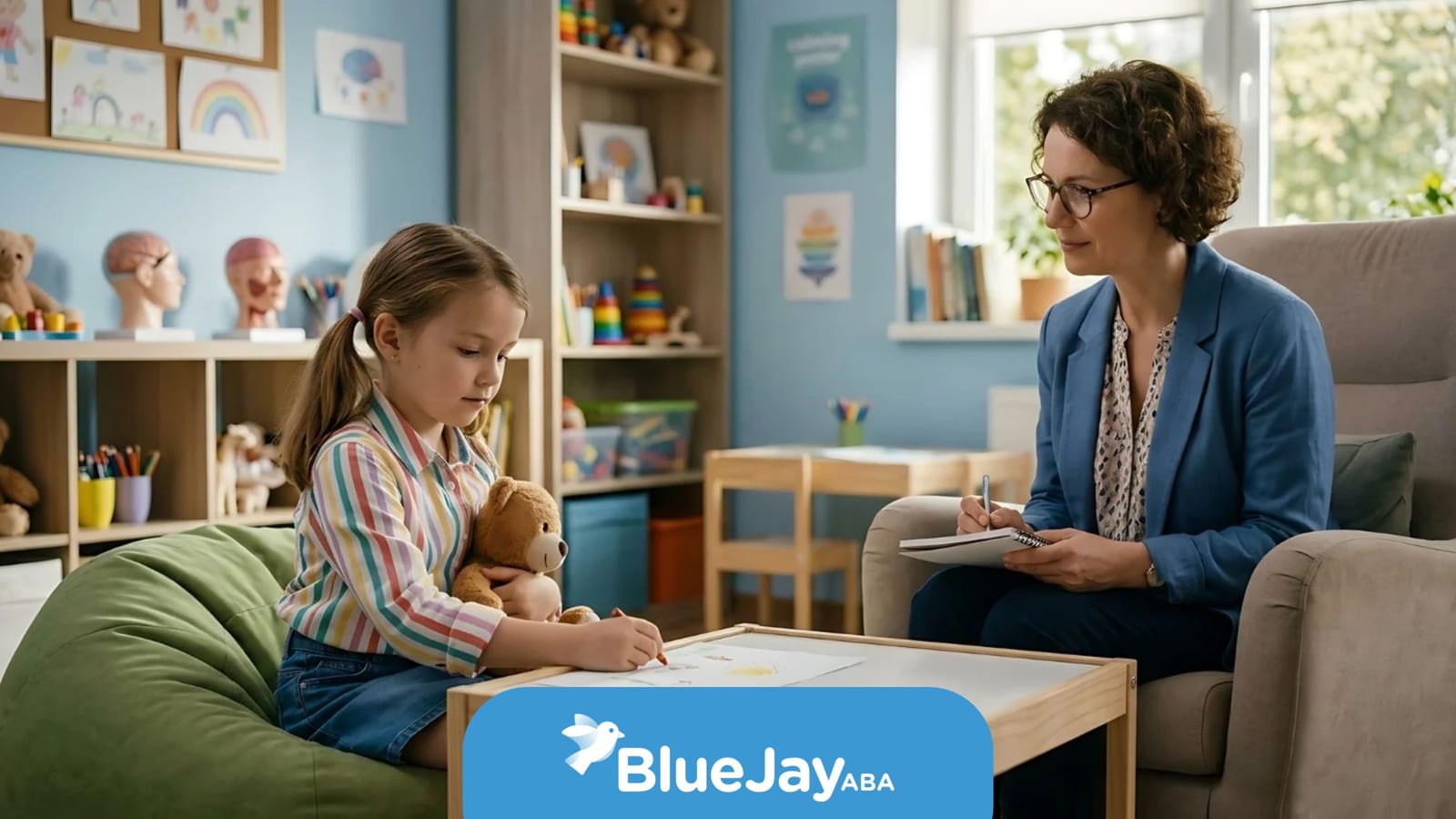
Parents often arrive picturing a test with right and wrong answers. The room is closer to a structured playdate with a clinician who is taking careful notes.
What Is the ADOS-2 and How Does It Fit Into an Autism Evaluation?
ADOS-2 stands for Autism Diagnostic Observation Schedule, Second Edition. It gives clinicians a consistent way to watch social communication and play, and it is almost never used by itself.
A Standardized Way to Watch Social Communication and Play
The clinician uses planned activities and materials that create chances for social interaction, then records what happens. Observations fall into areas such as communication, social interaction, play or imagination, and restricted or repetitive behaviors.
Researchers describe the earlier ADOS as widely accepted as a "gold standard" diagnostic instrument, and the toddler module was designed to extend it to very young children.
One Piece of a Larger Picture
CDC's guidance for clinicians says no single tool should be the basis for an autism diagnosis. Diagnosis usually draws on two sources: caregivers' descriptions of the child's development and a professional's observation of behavior. The clinician then compares everything to the DSM-5 criteria.
That is why your own account of your child matters so much. The ADOS-2 shows a snapshot, and your history fills in the rest.
ADOS-2 Modules by Age and Language Level
Your child takes one module, chosen by expressive language level and age. The choice does not depend on how severe anyone expects autism to be. Publisher descriptions of the five modules look like this, and your clinician will confirm which one fits.
Module | Who it is for |
Toddler Module | Children 12 to 30 months who do not consistently use phrase speech |
Module 1 | Children 31 months and older who do not consistently use phrase speech |
Module 2 | Children of any age who use phrase speech but are not verbally fluent |
Module 3 | Verbally fluent children and young adolescents |
Module 4 | Verbally fluent older adolescents and adults |
The Toddler Module
The Toddler Module was developed for children under 30 months who have nonverbal mental ages of at least 12 months. For this age group, results are reported as ranges of concern rather than a diagnostic label. Development moves fast in toddlers, so clinicians often recheck.
If your toddler recently screened positive, our post on M-CHAT-R/F results explains what that screening score does and does not mean.
Why Your Child's Module May Change
Language grows, and the module follows it. A child tested at 2 and again at 5 may take different modules. That is expected, and it does not suggest anything went wrong the first time.
What Your Child Does During the ADOS-2
Activities depend on the module, but most of the session is play and conversation. I will not list specific tasks, because the materials belong to the publisher and the session works best when it feels natural to your child.
For Younger Children
Expect toys and simple social games with the clinician. A parent is often nearby. The clinician watches for things like how your child shares attention, responds to a social bid, and uses gestures or sounds to communicate.
For Verbally Fluent Children and Teens
Older children may look at pictures, tell a story, or talk about everyday topics such as friendships and feelings. The clinician is listening for how conversation flows, how your child reads social situations, and how flexible their thinking is.
Where You Fit In
Ask ahead whether you will be in the room, because practice varies by age and module. Afterward, tell the clinician whether what they saw looked typical for your child. There is nothing to practice, and coaching your child to "perform" can make the observation harder to interpret.
Who Gives the ADOS-2 and How Long It Takes
Only clinicians who have the right training and meet the publisher's qualification requirements may give and score it. At UNC's TEACCH centers, for example, assessments are done by a licensed psychologist and other trained staff.
- The observation itself: each module takes about 40 to 60 minutes.
- The full appointment: longer, because it includes parent interviews and other measures. TEACCH lists visits that run from 1.5 to 6 hours.
- The report: scoring and writing come afterward. Ask when to expect it, since insurance plans and school teams will want a copy.
Some school teams also use the ADOS-2. Colorado Department of Education guidance lists it as one possible tool in an educational evaluation.
How ADOS-2 Scoring and Results Work
The clinician codes what they observed and enters those codes into a scoring form. What comes out depends on the module.
Classifications and Comparison Scores
For Modules 1 through 4, the totals fall into one of three classifications: autism, autism spectrum, or non-spectrum. Many modules also give a comparison score from 1 to 10 that sets your child's symptom level against children with autism of the same age and language level. That number makes it easier to see change over time.
What "Autism Spectrum" Means on a Report
A classification describes the pattern the clinician saw, measured against research-based cutoffs. It informs the diagnosis, and the clinician still weighs it against your child's history and the DSM-5 criteria. Two children with the same classification can need very different supports.
Why It Is Not Pass or Fail
No score here means a child did well or badly. The activities are designed so that any child can take part. The report describes patterns of communication, play, and behavior, and your clinician explains what those patterns suggest.
How the CARS-2 Adds a Second Perspective
Many clinics pair the ADOS-2 with the Childhood Autism Rating Scale, Second Edition. TEACCH uses both, and so do we.
The CARS-2 is a 15-item scale that the clinician completes using direct observation and caregiver information. Each item is rated on a four-point range, and the ratings add up to a total score. It has versions for younger children and for verbally fluent children age 6 and older. Because it draws on different information than the ADOS-2, it offers a useful second look.
What the ADOS-2 Cannot Tell You
Knowing the limits helps you read the report with the right expectations. The ADOS-2 does not:
- diagnose autism on its own
- explain why your child is autistic
- measure intelligence or academic skills
- identify co-occurring conditions such as anxiety or ADHD
- show which therapy or how many hours your child needs
- capture how your child behaves at home, at school, and with other people
Some behaviors can look like autism without being signs on their own, and our post on look-alike behaviors covers the common ones. Online screeners can raise questions, but online autism tests cannot replace a clinical evaluation.
After the ADOS-2: Next Steps for Your Family
Ask for the written report and a conversation about what it means. The report should include recommendations, and your pediatrician can help turn them into referrals for speech therapy, occupational therapy, or other supports.
If the report leads to an autism diagnosis, an ABA assessment is the next step for therapy planning, and ABA parent training can start building skills at home early. Our home-based ABA and school-based ABA therapy programs run in North Carolina and Colorado.
Have a referral in hand and a page of questions? Send them to our team and a clinician will help you sort which ones to bring to the appointment.
A Calm Way to Approach Your Child's ADOS-2
Think of the ADOS-2 as one conversation among several that will help a clinician understand your child. You do not need to prepare your child, and nothing about the day is a test of parenting. Share what you see at home, ask how results will be explained, and request the report in writing.
When your family is ready for what comes next, call 888-813-2583 and we will talk through how an ADOS-2 result can lead into support.
Frequently Asked Questions About the ADOS-2
How long does the ADOS-2 take?
The observation takes about 40 to 60 minutes per module. The whole appointment is usually longer because it also includes parent interviews and other measures.
Can a child fail the ADOS-2?
No. It is not a pass-or-fail test. It records patterns of communication, play, and behavior that a clinician interprets with your child's history.
Do parents stay in the room during the ADOS-2?
It varies by age, module, and clinic. Ask when you book, and plan to share your observations with the clinician afterward.
Can the ADOS-2 diagnose autism by itself?
No. CDC says no single tool should be the basis for diagnosis. Clinicians combine ADOS-2 results with caregiver information and the DSM-5 criteria.
What if my child is very young or does not use words yet?
The ADOS-2 has modules based on language level. The Toddler Module covers ages 12 to 30 months, and its results are reported as ranges of concern rather than a diagnosis.
Sources
- American Academy of Pediatrics. (2025). If autism is suspected, what's next? HealthyChildren.org. https://www.healthychildren.org/English/health-issues/conditions/Autism/Pages/If-Autism-is-Suspected-Whats-Next.aspx
- Centers for Disease Control and Prevention. (2025). Clinical testing and diagnosis for autism spectrum disorder. https://www.cdc.gov/autism/hcp/diagnosis/index.html
- Colorado Department of Education. (2020). Guidelines for the educational evaluation of autism spectrum disorder. https://www.cde.state.co.us/cdesped/asd_guidelines
- Luyster, R., Gotham, K., Guthrie, W., Coffing, M., Petrak, R., Pierce, K., Bishop, S., Esler, A., Hus, V., Oti, R., Richler, J., Risi, S., & Lord, C. (2009). The Autism Diagnostic Observation Schedule, Toddler Module: A new module of a standardized diagnostic measure for autism spectrum disorders. Journal of Autism and Developmental Disorders, 39(9), 1305-1320. https://pmc.ncbi.nlm.nih.gov/articles/PMC2893552
- TEACCH Autism Program, University of North Carolina at Chapel Hill. (n.d.). Evaluations. https://teacch.com/clinical-services/evaluations